LOCAL, STATE AND NATIONAL MUSINGS

Showing posts sorted by date for query riparian. Sort by relevance Show all posts

Dec 9, 2025

Water Runoff In Allentown Parks


I have been wrestling with the Allentown Park System for over twenty years about the weed walls, aka Riparian Buffers.The bout started in Keck Park, early in the Pawlowski Regime, when he allowed the Wildlands Conservancy to install their first buffer. 

The back stories are that Pawlowski's first of several park directors all had the same background in recreation from Penn State, and asked the Wildlands for advise about park issues. The Wildlands back story is that they get to keep 15% of all government grants that they apply for, as an administrative fee. Riparian Buffers are supposed to filter the lawn fertilizer in water runoff from entering the streams. The ignored reality in the Allentown Parks is that the storm system is piped directly into the streams, under any  buffer planted. Across Cedar Creek behind the Rose Garden, a large concrete structure discharges the entire runoff from the Hamilton Park neighborhood, directly into the creek. Likewise, several pipes empty the West End directly into the creek. So, for twenty years, we park devotees have been enduring weed walls all summer, blocking view and access to the creeks. Worse, this summer the city allowed the Wildlands to plant over a hundred tree saplings out from the creek, to expand the width of the masquerade. This area will soon also not be mowed, because mowing between closely planted trees is very labor intensive.

The current park director is asking the city for additional funds to study water runoff. The free answer is in the above paragraph. I would be happy to recommend needed repairs to various WPA structures within our parks, providing some value for that money.

Shown above is the weed wall in Cedar Park during the summer. 

I'm not here to be polite or popular

Jul 8, 2025

The Fountain Of My Youth

Just west of the Robin Hood Bridge is a fountain which quenched the thirst of my summer days. Built during the WPA era, it overlooked the creek. Although the water was turned off years ago, so now is the view. The weeds and assorted invasives growing are not a riparian buffer. Science says that a buffer has to be 25feet wide to be of any value. A reader described this thin strip of wild growth as neglect, masquerading as conservation. All it does is block both the view and access to the waterway. It denies our current citizens the beauty and experience for which the parks were designed. Although the Wildland's Conservancy would like you to believe that the Allentown Parks are there to be wildlands, in reality they were designed by landscape architects, to provide the citizens of Allentown with what Harry Trexler called serenity. He did also appreciate conservation, but for that he created the Trexler Game Preserve, north of Allentown. There are places in the parks which can accommodate the riparian buffer zones, without compromising the intended public experience of waterway view and access. Riparians could be created and maintained in the western side of Lehigh Parkway, between the pedestrian bridge and Bogerts Bridge. In Cedar Park, the riparian section could be in western side, between the last walking bridge and Cedar Crest Blvd. It's time that the parks were given back to the citizens of Allentown. They are not funded, or intended by our tax dollars and the Trexler Trust,  just to be a venue for the Wildland's Conservancy to harvest grants.  Let a child again giggle by the creek's edge. Let us get back our intended park experience.

above originally posted in 2013

ADDENDUM JULY 1, 2022: When the above post was first written, Pawlowski's recreation trained park directors farmed many actual park decisions out to the Wildlands.  Although their influence has waned somewhat in recent years, these faux buffers remain a negative legacy. The buffers are faux because Allentown's storm system is piped directly into the streams, under the buffer weed wall. Those weed walls in turn have become hotbeds of invasive species, such as Poison Hemlock.  Now, as the downside of those invasives has become obvious, the department is cutting the grass back toward the streams, but still leaving the creek edge overgrown, hiding view and blocking access.  To further complicate the situation, in the last several years all new tree plantings were done away from the creek, at the outer edge of the then wide buffer...The end result is now cutting the grass is more difficult, with all the new trees in the path of the mowers.

ADDENDUM DECEMBER 19, 2024: In recent years the park department has only cut down the faux fake excuse buffers only once or twice a season. Those cutting were necessary, so that the invasives would not take deep root. This year the invasives, in most places, were not cut at all! 

ADDENDUM JULY 8, 2025: I'm pleased to report that another suggestion of mine has filtered down to the ground crew. The weed wall in front of the fountain has been cut back, revealing the creek. The fountain remains inoperable, but that decision is beyond my pay grade. Unfortunately, the top of the wish list, the landings on the double stairwell, have yet to be repaired. That repair has been neglected for so long, that the landings are starting to sink down, making a former repaving job much more complicated.

Jul 7, 2025

The Little Bridge Of Lehigh Parkway


A few years ago, new and young visitors to the park would have no idea that a magnificent miniature bridge crossed a spring run to the Little Lehigh. Certainly, such a stone construction wasn't necessary to cross the 24 inch waterway. It was built in a era of masonry art, fueled by the Great Depression, and funded by Roosevelt's WPA. Over the last decade, budgetary cutbacks and environmentalists demanding riparian zones, justified allowing it to be consumed by brush and saplings. In 2010, I persuaded Mike Gilbert, park department manager, to partially clear around the bridge. Although a tree now blocks its southern approach, the bridge has been given a reprieve on its destruction.

reprinted from 2012

ADDENDUM JULY 18, 2022: While it has been another decade since I had the miniature bridge uncovered, I'm sorry to report that the WPA structures still remain a low priority with the city. While the wall into Lehigh Parkway has been restored out of necessity to retain entrance to the park, neglect for the other structures continues. I will continue to publicly complain about this shortcoming in the city's vision.

ADDENDUM JULY 7, 2025: Since I started campaigning for the spring pond and miniature bridge, it had been cleared twice...Once by by the city in 2010, and several years later by Friends of Allentown Parks, under Karen El-Chaar. A couple months ago, I again campaigned for the structure with a person influential with the park department. I'm happy to report that the miniature bridge has been cleaned up, along with one side of the spring pond. Although the stones lining the pond have not been cleared off, I'm grateful for the work that has been done, and hope that it remains on their schedule.

Jun 30, 2025

Jordan Meadows vs. The Rose Garden

As an advocate for the traditional park system, I have been campaigning against the Riparian Buffers for years. I think that people should be able to see the creek, at least around the Rose Garden in Cedar Park, and the Robin Hood section of Lehigh Parkway. Every park director since 2005 has disagreed with me. When I complained to current director Mandy Tolino about invasives in the weed wall, she replied that there were some natives mixed in. The city maintains that the buffer keeps the waterway cleaner.

Allentown has made an exception to their park policy in the Jordan Meadows. There, anything and everything goes, and goes into the creek. The growing homeless camp has a population of about a hundred people. The adjoining property owner, Nat Hyman, has noticed the contradiction, and made arrangements for a pending lawsuit. However, he is first giving the city another opportunity to address the homeless encampment, and has even offered to help fund a proper shelter.

Needless to say the encampment would not be tolerated along Cedar Creek by the Rose Garden. Last year one denizen and his tent got a quick boot.

related post at O'Hare's Ramblings

Apr 14, 2025

Bad Day For Allentown's Traditional Park System


Sunday was a rough day for Cedar Park. In cooperation with the City Park Department, dozens of eager Wildands Conservancy volunteers descended upon Cedar Park and planted dozens of trees, expanding the faux Riparian Buffer even out more from the creek. While some of the plantings took place in the most western section toward Cedar Crest Blvd., half the damage was done before the last walk bridge on the path loop. This former open space was prized by numerous dog owners, near one of the few places their pets can get a tick free drink!

The holes were dug earlier in the week by the park department. This cooperation between the department and Conservancy indicates that the department is as committed as ever to the faux buffer, aka Weed Wall. The Wildands owns hundreds of acres on South Mountain, where they could plant all the trees they want.  

I recently offended some officials by stating that the current public park input meetings are a political dog and pony show. If the city really cares about how the residents feel about the parks, they can read the Facebook group Allentown Chronicles. On the group, hundreds of residents have expressed their disgust with the weed walls.

Jan 6, 2025

Where's The Creek?

The young man seemed proud to be at the Old Fashioned Garden with his wife and child. I got the feeling that it was a rite of passage that he had enjoyed years earlier with his parents. He approached me with a quizzical look and asked Where's the creek? I assured him that it was still here, but hidden behind all that underbrush. When he asked me why they did that, I just shrugged my shoulders and walked away. I don't think he really wanted to hear a rant.

The Wildlands Conservancy had no resistance convincing the past two park directors to stop cutting the creek banks and call it a riparian buffer. Both directors were from out of town, trained in recreation at Penn State, and had no feeling or knowledge of the park's history and traditions. To add absurdity to the situation, the storm sewer systems in Allentown are piped directly into the streams, bypassing the buffers, making them useless to their stated purpose. To add further irony to the absurdity, the park department must now spray insecticide on the underbrush to control the invasive species. Worse than blocking access and view of the streams, the recent director endorsed the Conservancy demolishing two small historic dams, after being here only six weeks, and never actually having seen the dams himself.

Why do I dwell on water over the dam? The Wildlands Conservancy is now pitching the dam demolition and riparian buffer agenda to South Whitehall Township. If they get their way, the beautiful picnic vista overlooking Wehr's Dam will be replaced with a wall of weeds. I'm on a mission to make sure that beauty and history survive at Covered Bridge Park. 

above reprinted from September 9, 2014

ADDENDUM JANUARY 6, 2025: While I did, with the help of others,  save Wehr's Dam, I have had no such success with the creek banks in the Allentown parks. On the contrary, this season yet another new park director didn't even do the once annual invasive species mow down. 

Although I am a long time known advocate for the WPA, I was denied a seat at the new Parknership table.  I did manage to place a letter to the Morning Call that appeared yesterday, and I will continue to speak out in defense of the traditional park system.

Dec 19, 2024

The Fountain Of My Youth

Just west of the Robin Hood Bridge is a fountain which quenched the thirst of my summer days. Built during the WPA era, it overlooked the creek. Although the water was turned off years ago, so now is the view. The weeds and assorted invasives growing are not a riparian buffer. Science says that a buffer has to be 25feet wide to be of any value. A reader described this thin strip of wild growth as neglect, masquerading as conservation. All it does is block both the view and access to the waterway. It denies our current citizens the beauty and experience for which the parks were designed. Although the Wildland's Conservancy would like you to believe that the Allentown Parks are there to be wildlands, in reality they were designed by landscape architects, to provide the citizens of Allentown with what Harry Trexler called serenity. He did also appreciate conservation, but for that he created the Trexler Game Preserve, north of Allentown. There are places in the parks which can accommodate the riparian buffer zones, without compromising the intended public experience of waterway view and access. Riparians could be created and maintained in the western side of Lehigh Parkway, between the pedestrian bridge and Bogerts Bridge. In Cedar Park, the riparian section could be in western side, between the last walking bridge and Cedar Crest Blvd. It's time that the parks were given back to the citizens of Allentown. They are not funded, or intended by our tax dollars and the Trexler Trust,  just to be a venue for the Wildland's Conservancy to harvest grants.  Let a child again giggle by the creek's edge. Let us get back our intended park experience.

above originally posted in 2013

ADDENDUM JULY 1, 2022: When the above post was first written, Pawlowski's recreation trained park directors farmed many actual park decisions out to the Wildlands.  Although their influence has waned somewhat in recent years, these faux buffers remain a negative legacy. The buffers are faux because Allentown's storm system is piped directly into the streams, under the buffer weed wall. Those weed walls in turn have become hotbeds of invasive species, such as Poison Hemlock.  Now, as the downside of those invasives has become obvious, the department is cutting the grass back toward the streams, but still leaving the creek edge overgrown, hiding view and blocking access.  To further complicate the situation, in the last several years all new tree plantings were done away from the creek, at the outer edge of the then wide buffer...The end result is now cutting the grass is more difficult, with all the new trees in the path of the mowers.

ADDENDUM DECEMBER 19, 2024: In recent years the park department has only cut down the faux fake excuse buffers only once or twice a season. Those cutting were necessary, so that the invasives would not take deep root. This year the invasives, in most places, were not cut at all!

Oct 10, 2024

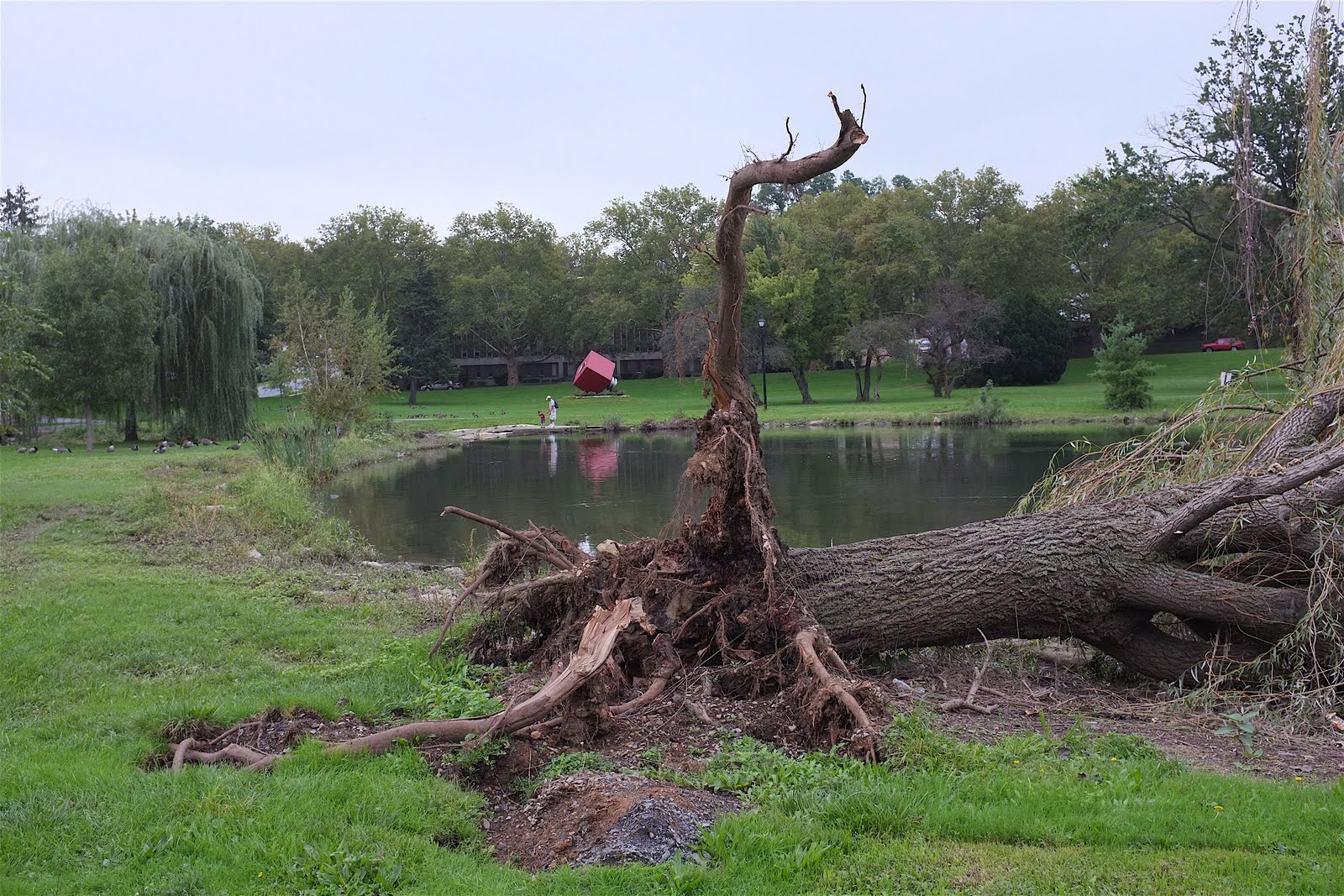
Another Storm, Another Old Willow Lost


When Irene stormed through Cedar Park, she knocked down and broke a number of the old willow trees. The sight of these magnificent trees along the creek banks is the view-shed cherished by us proponents of the historical park system. As a boy in 1955, I remember the same damage in the aftermath of Hurricane Diane. Many of the remaining willows are now about 75 years old, and at the end of their life span. Although they held the creek banks together for three generations, they have lost favor to riparian buffers.

It's nice to sit by the bank under a willow tree and watch the ducks swim by. Hopefully, somewhere along the banks of the Little Lehigh and Cedar Creek, there is still some open space for a few new weeping willows.

above reprinted from 2011

UPDATE APRIL 20, 2020:  The last nine years haven't been any kinder to the old willows. The photo above is from the most recent storm.  Although I purchased a willow to be planted in Cedar Park a few years ago, they refused to plant it along the creek edge.  Seems as if that is not permitted by the Wildlands Conservancy, which instead demands riparian buffers.  I put more faith in General Trexler's landscape architect of 1928, who ordered willow trees planted every 25 feet along the creeks.  Their shallow roots spread out and held the banks together for four generations of Allentonians.  They allowed us to enjoy the creeks as envisioned by the General and city fathers of the time. Hopefully, someday, some mayor will again reclaim our park system for the citizens of Allentown.

ADDENDUM OCTOBER 10, 2024:I've been fighting for the willows and the traditional park system for about two decades. Since 2006, one park director after another has come to resent this blog. Although I can't say I made any progress with the mission, I never doubted the value of my endeavor.

Aug 15, 2024

Weeping For The Allentown Park System

When Harry Trexler commissioned Frank Meehan of Philadelphia to design the Allentown parks, Meehan was considered the leading landscape architect in America.  It was because of Meehan that Allentown was shovel ready when the WPA started in the mid 1930's.  It was because of Meehan that our park system became the envy of cities everywhere.  

Throughout the park system he planted Weeping Willows thirty feet apart along the creeks. Their shallow, spreading root system provided the Little Lehigh, Cedar and Jordan Creeks erosion protection for almost a century. It provided both fish and fisherman beauty and shade along the creek banks.

Move ahead seventy five years, and in 2006 the from out of town new mayor Pawlowski combined the park and recreation departments, and hired a recreation major for department head. The new director turned over many park management decisions to the Wildlands Conservancy. The Wildlands introduced riparian buffers, even though the storm sewer system is piped directly into the creeks. As the Willows neared their lifespan and started dying out, they were not replaced. Rather, other trees were planted, back from the creeks, doubling down on the buffer concept.

We now realize that the creek banks are eroding, and that the buffers are incubators for invasive species. It is now the department's intention to seek outside consultants for recommendations. Rather than go outside again for advice, they should go back in history...Weeping Willows should be again planted along the banks. HOWEVER, the department REJECTS this suggestion, because willows are not indigenous. 

When I was a boy I lived above Lehigh Parkway in Little Lehigh Manor. My father's uncle worked for the park department cutting the grass along the creek. I'm saddened by the state of the overgrown creek banks, and the stubbornness of the city to not see the best solution.

Many of the original Willow trees have died, and the remaining ones are on their last legs.

above reprinted from May of 2022

Aug 13, 2024

A Rude Visit

When Irene stormed through Cedar Park, she knocked down and broke a number of the old willow trees. The sight of these magnificent trees along the creek banks, is the view-shed cherished by us proponents of the historical park system. As a boy in 1955, I remember the same damage in the aftermath of Hurricane Diane. Many of the remaining willows are now about 75 years old. Although they held the creek banks together for three generations, they have lost favor to riparian buffers.


It's nice to sit by the bank under a willow tree and watch the ducks swim by. Hopefully, somewhere along the banks of the Little Lehigh and Cedar Creek, there is still some open space for a few new weeping willows.
please click on photos to enlarge
photos by molovinsky

reprinted from September of 2011

ADDENDUM AUGUST 13, 2024:The bench shown above has been removed many years ago. Today the creek bank is so overgrown, it would provide no view anyway. While I might have a reputation for forthrightness not sought by the Parknership, I will continue my campaign for inclusion on their board. While I don't need the item on my resumé, there is a need for a traditional park system advocate. The Parknership is financed by Harry Trexler's vision almost a hundred years ago. That vision hired Meehan Associates (Landscape Architects) in 1928 to design our park system. More should remain of that vision of the parks than just a statue at the top of Trexler Park.

Jul 31, 2024

Beauty And The Beast Along Cedar Creek

The above scene is from Cedar Creek along the rose garden.  The creek banks have not been cut once this season. As an advocate for the traditional park system, the only solace I got from that situation was that the ducklings were spared from the usual spring massacre.

I did find the purple flowers pretty, and did feel a twitch of hypocrisy while taking the photo. Former park expert Michael Adams did inform me about my photograph....Purple Loosestrife, a beautiful but dreadful invasive... Michael is still an expert, but he was removed from the Parkway's Log and Stone house for political impurity by Pawlowski.

The new park director's background is in plant science.  She should wonder why both an opponent and a proponent of riparian buffers are upset by the condition of our creek banks.

May 10, 2024

Allentown Parks Can Kill Your Dog


Poison Hemlock has invaded the riparian buffers along the creeks in Allentown Parks.  These buffers are to accommodate the Wildlands Conservancy,  which essentially dictates all park policy, except recreation, in both Allentown and South Whitehall.  I suppose now the Wildlands can add pet killer to their dam buster credentials.

Allentown has been trying to control the problem by high rough cutting in spots where they see the hemlock.  The real solution is to go back to the way the parks were designed, without riparian buffers.

Frankly, I haven't had much success in curtailing the Wildlands Conservancy's influence in these park decisions. So far,  we lost two small historic dams, and the iconic Wehr's Dam is soon to go. We lost the view and access to the creeks in the park system, around which the parks were designed, by Harry Trexler's landscape architect. I have succeeded in creating a public record of these losses, and I will continue to speak out against how our parks are being compromised.

above reprinted from July of 2016

ADDENDUM JUNE 8, 2022: Park visitors may have noticed that the buffers have been cut down, except for a strip right along the creeks.  The cutting was done because the buffers were full of invasive species. Ironically, the remaining strips are almost exclusively Poison Hemlock, the worst of the invasives. More ironically, the park department has taken to planting the new trees on the outer edge of the buffer (instead of along the creeks), so now cutting the grass is so much more labor intensive. Thank the Wildlands Conservancy for this bastardization of the park system. The solution is to cut down the remaining strip, and start cutting the grass to the creek's edge, as prescribed by the park architect in the 1930's.  Furthermore, start planting willow trees along the creeks to combat erosion. 

ADDENDUM MAY 10, 2024:Cedar Park along the creek is once again infested with Poison Hemlock. It will always be that way until they start mowing the creek banks on a regular schedule. For the last five years or so, they control the Hemlock by cutting it down in late May, early June, just when the ducklings have hatched. I have no expectation that their schedule will change. Last season, not one duckling on the west side of the park survived. There were two families born on the Island in Muhlenberg Lake which fared better. If they would cut the creek banks along with the grass, the ducks would find safe places to nest. Instead, we have a stubborn park department, Poison Hemlock and ground up ducklings.

Apr 8, 2024

Allentown's New Highway of Mischief

I've been an opponent of bikes in the parks for a long time. The photo above is actually from an interview with Fox News many years ago which appeared on the Hannity Show. Now that Allentown is again gearing up their plans to interconnect the parks, I'm again sounding the alarm.

Back when that interview took place, the cyclists were suburban yuppies in spandex and helmets.  While that group is civilized, the danger was their speed  combined with old folks like me walking around.  The new danger is the junior thugs with electric bikes. Unlike the spandex yuppie, consideration isn't even something they aspire to.

The park interconnection will become a highway of mischief, with no police cars.  I know that there are destinations where bikes, motor vehicles and tourists respect each other, Allentown isn't one of them.

I'm an advocate for being site appropriate. In Allentown parks, the Riparian Buffers are weed walls.  In this era of dirt and electric bikes, interconnecting the parks will become another well meaning mistake.

Apr 1, 2024

Allentown's Poor Park Decisions

Allentown had one of the finest park systems in the United States, but one national fad after another has diminished it. 

After the Park and Recreation departments were combined, former mayor Ed Pawlowski  hired a succession of recreation trained directors, who in turn farmed out park policy to the Wildlands Conservancy.  The Conservancy, like many of our other local sacred cows, have more influence than expertise, and promote trendy fads, not always site appropriate.  

While the banks of our park streams were secured with Weeping Willows, rather than replace the aging willows, the Conservancy pushed for Riparian Buffers.  The buffers become infested with invasive species which have to be cut down several time a season. Several years ago Allentown was warned by the DEP about Poison Hemlock infecting our drinking water supply from the Little Lehigh. Before the downside of these buffers were fully realized by the park department, all the new trees were planted out away from the creeks, only complicating the grass mowing. In the meantime, our citizens are cut off from both access and beauty of the creeks.

The Wildlands Conservancy, also in alignment with national trends, demolished two important dams on the Little Lehigh. After demolishing the Fish Hatchery Dam, that facility suffered the biggest fish loss in its history from flooding. Demolishing the Robin Hood Bridge Dam has despoiled the beautiful bridge piers and that immediate area, which formally was the pride of the park system.

I take great pride in having fought against all the above violations by the Conservancy. While I lost those battles in Allentown, I was able to help save Wehr's Dam in Covered Bridge Park from their schemes.

What brings me back to the parks today* is the announcement that Allentown has secured a grant to continue its plan to connect the parks with a trail. While the promotion states that the Trail Network is for walkers and cyclists, reality is very much different. As a walker, I can tell you that any of the Allentown parks is long enough...The connection is really for the cyclists. Any walker in the park will tell you that it's frightening and dangerous when a cyclist zooms by you. 

As a longtime advocate for the parks, I could show the city where this grant money could be much better spent in restoring neglected existing features in our parks. We do not need to connect the neglect, but rather address and save our separate parks.

Decades ago picture postcards of our park system would be sent across the country. Now-a-days. those images are nostalgic reminders of what we've lost.

1955 picture postcard of Lehigh Parkway, before being despoiled

*Over the weekend Mayor Tuerk admired the creek bank in Lehigh Parkway. He should realize that by mid-summer that bank will be hidden with a 6' tall weed wall under current park policy. Also over the weekend state representative Pete Schweyer announced Allentown was awarded the grant to connect the parks. He should realize that we would be better off restoring the parks, instead of connecting them.

Nov 6, 2023

The Fountain Of My Youth

Just west of the Robin Hood Bridge is a fountain which quenched the thirst of my summer days. Built during the WPA era, it overlooked the creek. Although the water was turned off years ago, so now is the view. The weeds and assorted invasives growing are not a riparian buffer. Science says that a buffer has to be 25feet wide to be of any value. A reader described this thin strip of wild growth as neglect, masquerading as conservation. All it does is block both the view and access to the waterway. It denies our current citizens the beauty and experience for which the parks were designed. Although the Wildland's Conservancy would like you to believe that the Allentown Parks are there to be wildlands, in reality they were designed by landscape architects, to provide the citizens of Allentown with what Harry Trexler called serenity. He did also appreciate conservation, but for that he created the Trexler Game Preserve, north of Allentown. There are places in the parks which can accommodate the riparian buffer zones, without compromising the intended public experience of waterway view and access. Riparians could be created and maintained in the western side of Lehigh Parkway, between the pedestrian bridge and Bogerts Bridge. In Cedar Park, the riparian section could be in western side, between the last walking bridge and Cedar Crest Blvd. It's time that the parks were given back to the citizens of Allentown. They are not funded, or intended by our tax dollars and the Trexler Trust,  just to be a venue for the Wildland's Conservancy to harvest grants.  Let a child again giggle by the creek's edge. Let us get back our intended park experience.

reprinted from August of 2013

Apr 21, 2023

Weeping For The Willows

Fans of the Allentown park system see that the willows are in their last years.  Planted in the mid 1930's, they have served both the parks and citizens well.  Harry Trexler commissioned the leading landscape architect of his era to design the parks. Meehan Associates of Philadelphia specified that willow trees be planted thirty feet apart along the creeks.  The shallow, extensive root system of the Willows prevented erosion, and provided shade for the creeks and citizens.

Riparian buffers have become fashionable in current ecological circles.  Their intent is to filter out nitrogen from lawn fertilizer entering streams.  They were instituted in Allentown parks in 2006 on that false pretense, and seen by the park department as a way to also reduce mowing. However, in Allentown the reality is different. The storm water system is piped directly into the creeks, under these buffers. Worse, the buffers incubated invasive species, whose removal is much more labor intensive than simply mowing the grass. The park department is now realizing that the buffers are not Allentown park appropriate.  

I recently suggested to a park official that new willows start being planted along the creeks. The reply was that willows are not indigenous, that's another new ecological buzz term. Willows however remain recommended for bank erosion. 

The parks are not indigenous, nor are the swimming pools or the basketball courts.  The willows do however provide erosion control, are not invasive, provide shade for both people and fish, and are beautiful to boot... Not a bad idea Mr. Meehan had back in the 1930's.

I think that the park department need remember that they are managing parks, not indigenous species conservation districts.  More important is that these parks are for people to enjoy. A child playing by a creek bank is an experience now lost from Allentown, that we need to get back.

Apr 20, 2023

Weeping For The Allentown Park System

When Harry Trexler commissioned Frank Meehan of Philadelphia to design the Allentown parks, Meehan was considered the leading landscape architect in America.  It was because of Meehan that Allentown was shovel ready when the WPA started in the mid 1930's.  It was because of Meehan that our park system became the envy of cities everywhere.  

Throughout the park system he planted Weeping Willows thirty feet apart along the creeks. Their shallow, spreading root system provided the Little Lehigh, Cedar and Jordan Creeks erosion protection for almost a century. It provided both fish and fisherman beauty and shade along the creek banks.

Move ahead seventy five years, and in 2006 the from out of town new mayor Pawlowski combined the park and recreation departments, and hired a recreation major for department head. The new director turned over many park management decisions to the Wildlands Conservancy. The Wildlands introduced riparian buffers, even though the storm sewer system is piped directly into the creeks. As the Willows neared their lifespan and started dying out, they were not replaced. Rather, other trees were planted, back from the creeks, doubling down on the buffer concept.

We now realize that the creek banks are eroding, and that the buffers are incubators for invasive species. It is now the department's intention to seek outside consultants for recommendations. Rather than go outside again for advice, they should go back in history...Weeping Willows should be again planted along the banks. HOWEVER, the department REJECTS this suggestion, because willows are not indigenous. 

When I was a boy I lived above Lehigh Parkway in Little Lehigh Manor. My father's uncle worked for the park department cutting the grass along the creek. I'm saddened by the state of the overgrown creek banks, and the stubbornness of the city to not see the best solution.

Many of the original Willow trees have died, and the remaining ones are on their last legs.

above reprinted from May of 2022

More on the Willows tomorrow

Mar 22, 2023

Crimes By The Wildlands Conservancy

photo by Tami Quigley

The top photo shows the Robin Hood Bridge, before the Wildlands Conservancy demolished the little Robin Hood Dam, just downstream beyond the bridge. The dam was only about 10 inches high, and was built as a visual effect to accompany the bridge in 1941. It was the last WPA project in Allentown, and considered the final touch for Lehigh Parkway. Several years ago, the Wildlands told the Allentown Park Director and City Council that it wanted to demolish the dam. The only thing that stood between their bulldozer and the dam was yours truly. I managed to hold up the demolition for a couple weeks, during which time I tried to educate city council about the park, but to no avail. If demolishing the dam wasn't bad enough, The Wildlands Conservancy piled the broken dam rubble around the stone bridge piers, as seen in the bottom photo. I'm sad to report that the situation is now even worse. All that rubble collected silt, and now weeds and brush is growing around the stone bridge piers. I suppose the Wildlands Conservancy considers it an extension of its riparian buffers.

The Wildlands Conservancy is now going to demolish Wehr's Dam at Covered Bridge Park in South Whitehall. The township commissioners are cooperating, by having a grossly inflated price associated with repairing the dam, to justify a disingenuous referendum. Sadly, by next spring I will be showing you before and after pictures of that crime.


top photo by Tami Quigley

above reprinted from August 2016

UPDATE: To everyone's surprise, especially the Wildlands Conservancy and the South Whitehall Commissioners, the referendum to save the dam was approved by the voters in November of 2016. The Wildlands Conservancy and the South Whitehall Commissioners are now conspiring to have the dam demolished anyway, by exaggerating its problems with the Pa. DEP...I have documented the communication between the Wildlands, State and township,  As for Lehigh Parkway, the Wildlands Conservancy should be made to remove the former dam rubble that is despoiling the vista of the Robin Hood Bridge piers.  I have been trying to interest the Morning Call about the voter suppression in regard to the Wehr's Dam referendum.  In today's paper there is an article about the danger high hazard rated dams pose to residents downstream.  I hope the paper's article today is a coincidence, and not intended to serve the Wildlands conspiracy about Wehr's Dam.  BTW,  Wehr's Dam is rated low hazard, because it poses no danger to residents.

reprinted from November of 2019 and before

UPDATE MARCH 22, 2023: I'm pleased with my part in saving Wehr's Dam. In 2014, the former commissioners were ready to approve the dam demolition by the Wildlands Conservancy, and I prevailed upon them to give a couple more weeks for public input. After Allentown city council approved demolishing the small Robin Hood Dam, the Wildlands had it removed within two days. The articles about that South Whitehall meeting alerted several people, including the descendants of Wehr family. The Wehr's and others did a great job campaigning to save the dam. After weeks of rejecting my editorial letter, the Morning Call finally printed my plea to save the dam before the referendum vote. 
The former commissioners still cooperated with the Wildlands Conservancy in their efforts to demolish the dam, even after the referendum. The dam's future was only actually secured with the new current set of commissioners, and the dam itself was only finally repaired this past summer and fall. 

While I now have faith in the future of Wehr's Dam, the Robin Hood Bridge remains a sorry sight. In my opinion, the Wildlands should pay to have the rubble they deposited by the bridge piers removed. But in the meantime, the city should remove the rubble this summer, and pay the bridge beauty some overdue respect.

Mar 21, 2023

A Park Primer For The New Administration

A local activist, Tyler Fatzinger of Fairview Cemetery fame, wrote on Facebook yesterday...

I once attended a community meeting and the mayor was there. The community said how ugly the (park) banks were and wanted them back to how they were for so many years. The mayor responded that the banks were for erosion control and he trusted those individuals who made those decisions because they went to school and had a degree in that field.
In the early 1920's,  Harry Trexler had the park system designed by Meehan Associates of Philadelphia,  the country's leading landscape architectural firm of that time.  They specified that willow trees be planted along the creeks. The spreading shallow root system of those trees  held the banks firmly in place for over 70 years. More so, they allowed both view and access to the creeks.  Families and their children enjoyed the parks for generations.  In 2005, mayor Pawlowski hired a series of  park directors who all had the same background in recreation from Penn State. They were content to farm out park maintenance decisions to the Wildlands Conservancy, which was more than glad to administer grants for the park system. The Wildlands harvested 15% administrative fee for each grant. Their specialty is popular conservation trends, regardless of local specifics. They instituted riparian buffers, which are supposed to filter lawn fertilizer runoff from entering the creeks. In Allentown, however, the storm sewer system is piped directly into the creeks, under the buffers, making them useless for that designated purpose. Meanwhile, as the willow trees started dying out from age, they were not replaced.  This series of recreation trained directors, all from out of town, couldn't care less that both the view and access to the creeks were blocked. One of them told me that when you can only catch a glimpse of the creek, it is more exciting.  Neither The Wildlands Conservancy,  nor their park director lackeys,  realized that these weed walls would cultivate invasive species, including Poison Hemlock.  So the buffers still have to be cut down several times a season, especially with the Little Lehigh and Cedar Creek being sources for the water plant on Martin Luther King Drive.

The time has come to restore the Allentown parks to their former glory.  It's time to plant new willow trees along the banks. Allentown was known for its park system, featured on numerous picture postcards...Let's restore that fame.

postcard of Robin Hood Bridge, Lehigh Parkway, 1955

Mar 20, 2023

A Duckling Story In Allentown

Local noted photographer Hub Willson took the extra cute capture shown above in 2010, at a Rose Garden pond.  In the last few years such a photograph would not have been possible, no ducklings survived the grass mowing.

Readers may recall that last year, and in the recent preceding years, I tried to prevent that carnage here on this blog.  Last year, in addition to the park leadership, I even contacted Mayor and Mrs. Tuerk, all to no avail. 

The problem is the fake riparian zones.  The park department feels that they must mow in the spring to curtail the invasive species. Although they claimed to look for nests before mowing, that was like looking for the proverbial needle in the haystack.  If they would keep it mowed, as they did in 2010, the ducks would still find suitable spots for their nests. However, when they don't mow during mating season, then mow after the nests are built,  the season's ducklings are destroyed.

The park department either needs to keep the banks mowed on a regular schedule, or wait to mow after the ducks have left the nest. At that point the grass would be quite high, and it would involve more machinery and labor. 

The park department realizes that because the storm water system is piped under the buffer, directly into the creek, that the buffer doesn't really buffer.  However, it does provide an excuse to cut back somewhat on the mowing budget.  However, the invasive species thrive along the uncut banks, especially Poison Hemlock. Late last summer the park department was mandated to cut the banks, because the invasive situation was so out of hand.

The time has come for the department to return to regular cutting of the banks, as they do with the meadows. Ironically, now it will be more costly, because they planted the new trees along what they hoped would be the outer buffer line. Nevertheless, the health of the park and the ducklings demand it.